Design Agency vs Freelancer vs In-HouseThe Real Cost for Startups
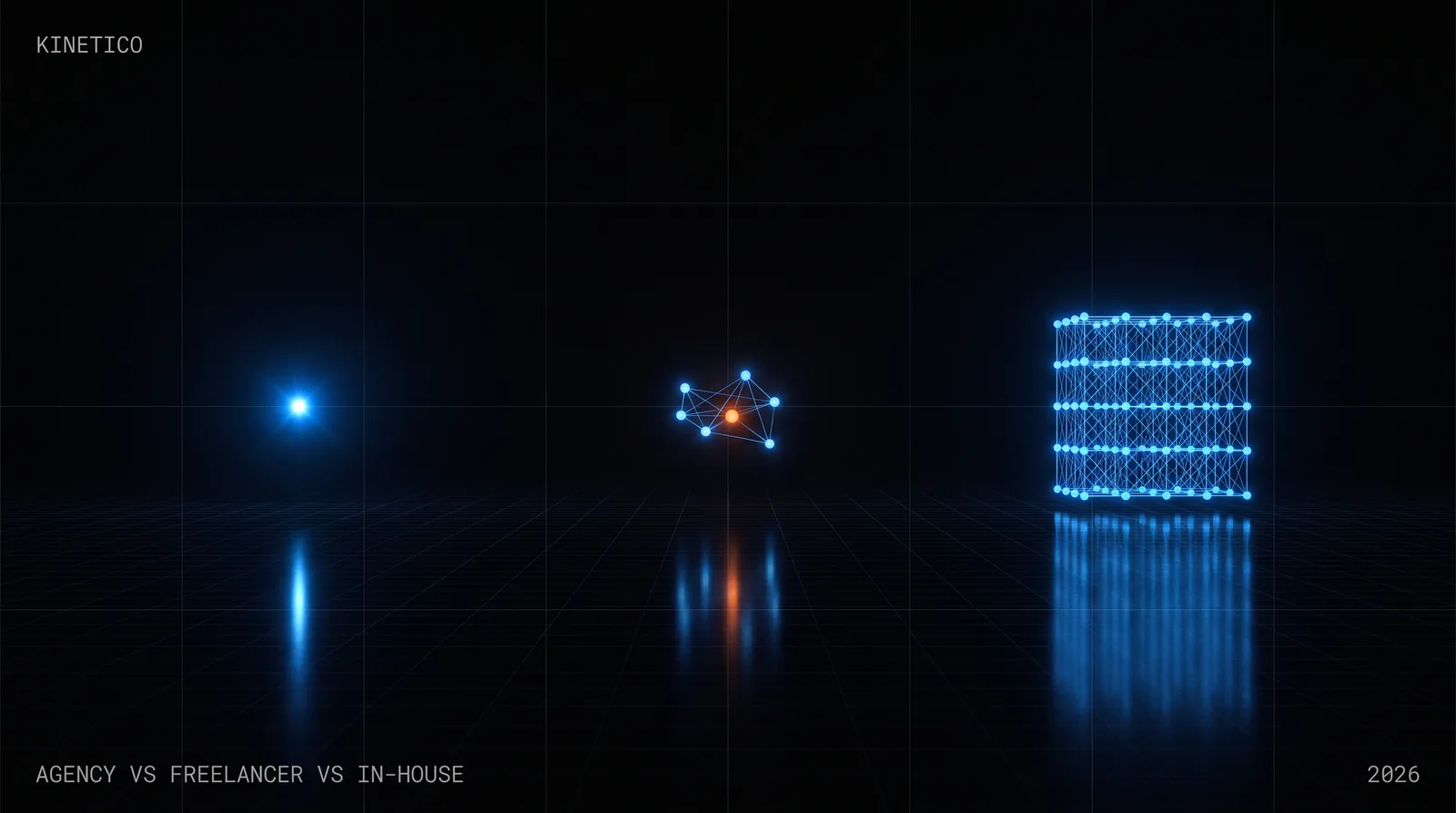
For startups, the right design hire depends on stage, not budget. A senior freelancer fits pre-seed validation — fast and 40–60% cheaper than an agency. A design agency earns its premium at MVP-to-launch through capability density. An in-house hire only pays off once design is continuous, after product-market fit. Kinetico, a Pokhara product design and engineering studio, has played all three roles.
That's the short answer. The rest of this guide is the honest breakdown — what each model really costs, where it breaks, and how to match it to the stage your product is in right now. If you want the agency option priced, our product design service page has the deliverables and tiers; in-house vs outsourcing asks the same question about engineering.
Key Takeaways
- •Choose by stage: freelancer for validation, agency for launch, in-house once design is continuous.
- •Freelancers cost 40–60% less but can't hold brand, product UX, and a design system at once.
- •Agencies win on capability density and lower the risk of an expensive rebuild.
- •An in-house designer is the most expensive idle resource you can hire before product-market fit.
- •The real cost isn't the day rate — it's what a wrong choice does to your timeline.
Why Do Founders Get This Decision Wrong?
Most founders frame this as a price comparison: freelancer cheap, agency expensive, in-house somewhere in between. So they pick the cheapest option that looks like it can do the job — and three months later they're re-hiring, because the choice never matched the work.
The day rate is the least important number in this decision. What actually matters is the shape of the work: Is it a one-off or ongoing? Narrow or broad? Throwaway or load-bearing? Get those answers right and the model picks itself. Get them wrong and even the cheapest option becomes expensive — paid twice, or paid in lost months.
How Do the Three Models Compare?
| Model | Cost | Speed | Main risk | Best stage |
|---|---|---|---|---|
| Freelancer | 40–60% less than an agency | Fast to start, fast to pivot | Single point of failure; thin on breadth | Pre-seed validation, defined scope |
| Agency | Highest day rate, lowest rebuild risk | Full team ships in parallel | Coordination overhead, needs clear priorities | MVP-to-launch, complex or regulated |
| In-House | Salary + benefits + recruiting time | Slow to hire, fastest once embedded | Underutilization before product-market fit | Continuous design, post-PMF |
When Is a Freelancer the Right Call?
For most pre-seed founders with a defined brief and a tight timeline, a strong senior freelancer is the pragmatic choice. Someone who has shipped early-stage products before can move quickly, operate with minimal process overhead, and adapt as the brief changes — and at a stage where what you're producing is essentially throwaway material that exists to inform the real build, that's exactly what you want.
The catch is breadth. A single designer — even an excellent one — is unlikely to hold the full product coherently while shipping new features, maintaining a design system, and responding to what the data is showing. Freelancers are a scalpel, not a Swiss Army knife. Hand one a narrow, well-defined job and they're unbeatable on value. Hand them everything and the cracks show fast.
Freelancers also pair naturally with a lean budget. If you're still pressure-testing what your product needs to cost at all, start with our breakdown of what it costs to build a SaaS MVP before you commit to any hiring model.
When Does an Agency Earn the Premium?
For founders building in complex categories — fintech, regulated industries, multi-sided platforms — or for teams at the MVP-to-launch stage where the stakes are higher, a specialist product design agency is usually worth the difference in cost. Agencies win on capability density: brand, website, product UX, motion, and design systems, all coordinated under one roof, shipping in parallel rather than in sequence.
That breadth is also what protects you from the most expensive mistake in early product: building something you have to throw away the moment you get traction. A good agency builds a foundation that bends instead of breaks — the exact trap we map out in the MVP development process. The premium you pay is, in part, insurance against a six-figure rebuild.
The honest downside: agencies cost more per day and require you to bring clear priorities. They're a force multiplier on a sharp brief and an expensive way to discover you don't have one. If you go this route, our guide on how to choose a product development agency covers the seven criteria that separate partners who deliver from those who delay.
When Should You Bring Design In-House?
An in-house designer is the most expensive idle resource you can hire too early. Before product-market fit, design work tends to be bursty — intense around a launch, quiet after. A salaried hire during the quiet stretches is pure burn, plus the recruiting time it took to find them.
The signal that it's time to hire in-house is continuity: the product ships weekly, design decisions compound, and you need one consistent owner who carries context day to day. At that point an embedded designer is the fastest model there is — no re-briefing, no context handoff. The mistake is hiring for that future before you're living in it.
“Hire a freelancer to learn, an agency to launch, and an employee to sustain. The error is using the right model at the wrong time.”
Can You Combine Agency, Freelancer, and In-House?
These aren't mutually exclusive, and the smartest teams sequence them. A common path: a freelancer to validate the concept, an agency to design and build the launch-grade product and its foundations, then a first in-house hire to own the product day to day — with the agency staying on retainer for the broad pushes (a rebrand, a new surface, a marketing site) that a single hire can't absorb.
Thinking of it as a sequence instead of a single permanent choice is what keeps you from over-hiring early or under-resourcing at launch. The question isn't “which one forever” — it's “which one for the next two quarters.”
Frequently Asked Questions
Should a startup hire a design agency, a freelancer, or in-house?
It depends on stage. Pre-seed founders validating an idea are usually best served by a senior freelancer. At MVP-to-launch, or in complex categories like fintech, an agency's full-team capability is worth the premium. An in-house hire makes sense only once design is continuous and you can keep one person fully utilized.
Is a freelancer cheaper than a design agency?
Yes — typically 40–60% less for the same project, because there's no team overhead. But a single freelancer can't simultaneously hold brand, product UX, a design system, and motion the way an agency team can, so the lower rate can cost more if the work needs that breadth.
When is a design agency worth the higher cost?
When the stakes are high and the scope is broad — MVP-to-launch products, regulated or complex categories, or anything needing brand, website, product UX, motion, and a design system under one roof. Agencies win on capability density and reduce the risk of an expensive rebuild.
When does hiring an in-house designer make sense?
When design work is continuous rather than project-based and you can keep a designer fully utilized — typically post product-market fit, when the product ships weekly and needs a consistent owner.
How Do You Match the Model to Your Stage?
There's no universally “best” way to resource design — there's only the model that fits where your product is right now. Freelancers buy you speed and cheap learning. Agencies buy you breadth and a foundation that lasts. In-house buys you continuity once you've earned the right to it.
The cost that matters isn't the invoice — it's the timeline you lose when the model doesn't fit the work. Choose for the stage you're in, not the company you hope to become.
If you're at the launch stage and weighing whether an agency is the right move, that's exactly the conversation we have with founders every week — starting from what your product actually needs to prove, not from a pitch.
Who Wrote This, and What It's Based On
Written by Pukar Khanal and the Kinetico team, a product design and engineering studio based in Pokhara, Nepal. This guidance comes from 3 years of shipped product work across payments, hospitality, and interaction-heavy interfaces — during which Kinetico has worked as the freelancer's alternative, the launch agency, and the retained partner alongside in-house teams. The 40–60% freelancer cost differential reflects current 2026 market ranges; everything else is first-party experience, deliberately including cases where a freelancer is the better call than hiring us.
Published 2026-06-10 · Last reviewed 2026-06-10 · Author: Pukar Khanal, Kinetico Engineering Team
Continue Your Research
How Much Does It Cost to Build a SaaS MVP? →
Real 2026 ranges by builder type and feature scope.
If you pick an agencyHow to Choose a Software Development Company →
Seven criteria that separate partners who deliver from those who delay.
If you pick an outside teamStaff Augmentation vs Outsourcing: Studio, Dev Shop, or Augmented Team →
Three ways to buy development — what each sells, and where each one stops working.
What the process looks likeThe MVP Development Process, Week by Week →
Five stages, an 8-week calendar, and why one team means no handoff.
Not sure which fits?Talk Through Your Stage with Kinetico →
A straight answer about your stage — even if it's “hire a freelancer.”
Not sure whether your stage calls for an agency? Tell us where your product is — we'll give you a straight answer, even if it's “hire a freelancer.”
Related articles
In-House vs Outsourcing Software Development: How Should a Startup Decide?
In-house vs outsourcing, decided by one question — do you have a technical lead to hire around? Who employs, directs, owns and supports, side by side; cost, speed, control, talent and scale with sourced 2026 numbers; what a US in-house team costs against a fixed-price first version; when to build in-house, when to outsource, and the sequence most funded startups end up with.
How to Choose a Software Development Company: 7 Criteria Founders Use
How to choose a software development company or partner: the 7 criteria that separate teams who ship from teams who delay, with the evaluation questions to ask and the red flags to walk away from.
Staff Augmentation vs Outsourcing: Product Studio, Dev Shop, or Augmented Team?
Staff augmentation vs outsourcing, compared honestly — an augmented team you direct, a dev shop that executes your spec, or a product studio that owns the outcome. Who directs, who owns, what it costs, and the stage where each stops working.