Staff Augmentation vs Outsourcing: Product Studio, Dev Shop, or Augmented Team?
The three ways to buy product development — an augmented team you direct, a dev shop that executes your spec, or a product studio that owns the outcome — compared on who directs, who owns, what it costs, and the stage where each stops working.
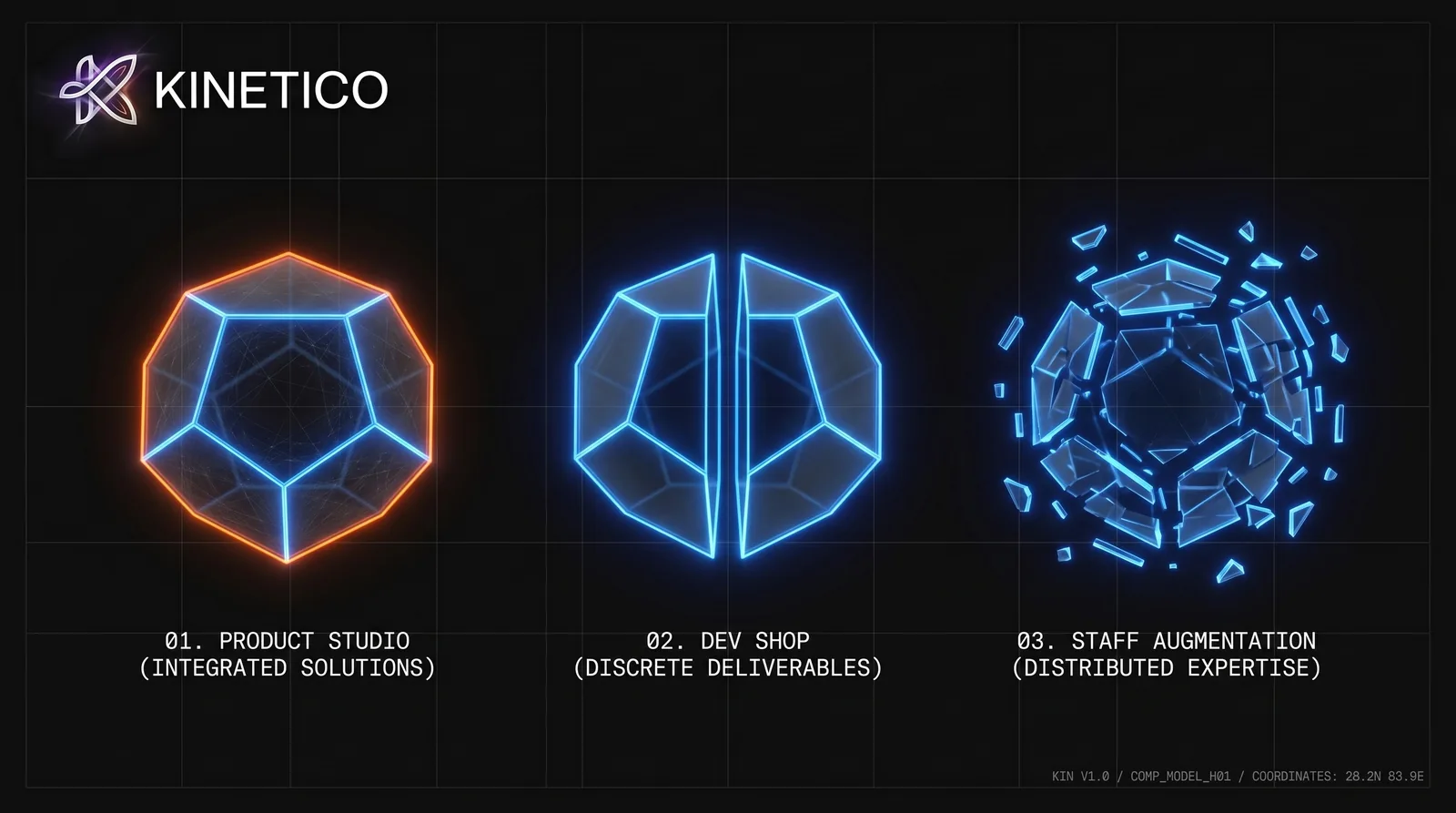
Staff augmentation vs outsourcing comes down to who directs the work. Augmentation adds engineers you manage; outsourcing hands it to a vendor — a dev shop that executes your spec, or a product studio that owns the outcome. Choose by what you lack: hands, execution, or judgement.
Kinetico operates as a studio, and this guide is honest about when that is the wrong choice. The comparison below covers all three models on the dimensions that actually decide it — direction, ownership, overhead, cost predictability, IP, and how each one fails.
Key Takeaways
- •Staff augmentation vs outsourcing is a question of direction: augmentation adds people you manage; outsourcing (dev shop or studio) hands the work to a vendor. Neither is a quality tier — they are different products.
- •Hourly rate is inversely correlated with how much thinking is included. Cheaper models move cost onto your team rather than removing it.
- •The decisive question is not budget. It is whether the specification is settled.
- •A dev shop that builds the wrong specification perfectly is the most expensive outcome available to you.
- •Most teams should change models at least once. The mistake is staying in a model after the constraint it solved has gone away.
Staff augmentation vs outsourcing: what is the actual difference?
“Outsourcing” is doing two jobs in that phrase. Most comparisons treat it as one thing, but a founder buying outsourced product development is choosing between two very different vendors: a dev shop that builds what you specified, and a product studio that decides with you what to build and then builds it. Staff augmentation (called outstaffing in much of Eastern Europe) is the third option: the vendor supplies engineers, you supply everything else. Side by side:
| Dimension | Staff augmentation | Outsourcing — dev shop | Outsourcing — product studio |
|---|---|---|---|
| Who directs the work day to day | You — your PM, your architecture, your standups | The vendor, against your written specification | The studio, against an agreed outcome |
| Who owns the outcome | You | You (the shop owns delivery of the spec) | The studio |
| Management overhead on your side | High — review, prioritisation, onboarding | Medium — spec, acceptance, change requests | Low — one accountable team, weekly demos |
| Cost predictability | Monthly per seat; total depends on your velocity | Fixed or T&M per spec; changes cost extra | Fixed per scope; scope changes renegotiated |
| Blended rate (2026) | $25 – $70 / hr | $35 – $90 / hr | $60 – $150 / hr (Kinetico: $15k–$50k per build) |
| Speed to start | 1–3 weeks to place people | 2–4 weeks (spec + estimate) | 1–2 weeks (scoping call → fixed number) |
| IP and code ownership | Yours by default — it's your repo | Yours by contract; check the clause | Yours; the studio should work in your GitHub org |
| Scaling up or down | Easy — add or remove seats | Per project; new spec, new quote | Per engagement; next build is a new scope |
| Best when | You have leadership and need hands | The spec is settled and correct | The spec is the risk (pre-product, zero-to-one) |
Staff augmentation vs project outsourcing: pros and cons
Staff augmentation — for: lowest hourly rate, fastest to scale up or down, engineers work in your repo and your process, IP is never in question. Against: you carry recruitment-grade risk on every seat, management and review overhead lands on your senior people, and without a strong internal lead the output is code nobody owns.
Project outsourcing (dev shop) — for: a fixed price against a fixed spec, low management overhead, a full team you didn't have to assemble. Against: specification risk stays with you; every change is a change request; design is often subcontracted, so screens get re-interpreted on the way to code.
Project outsourcing (product studio) — for: one accountable team from scope to production, design and engineering by the same people, a fixed number for an outcome rather than a feature list (this is Kinetico's MVP development service). Against: the highest hourly rate, and it's the wrong purchase when your spec is genuinely settled — you'd be paying for judgement you don't need.
For what the studio model costs in absolute terms — $15k–$50k over 6–12 weeks at Kinetico — see how much it costs to build an MVP.
The distinction nobody explains clearly
Every firm in this market describes itself with the same words — partner, end-to-end, senior team, proven process. The marketing language has fully converged, which means it carries no information. What actually separates these businesses is narrower and more useful: how much of the thinking is included in the price, and who is accountable when the product does not work.
That is the whole distinction. Everything else — team size, location, tech stack, how nice the deck is — is secondary to those two variables. Once you hold them fixed, the choice usually makes itself.
Product studio — you are buying judgement
A studio takes a position on what should be built. You bring a problem, a constraint, and a budget; the studio brings an opinion about the shape of the solution and accepts responsibility for whether that shape works. Scoping, design, and engineering sit inside one accountable unit, which is what lets a studio say “that feature should not exist” and mean it.
The value is concentrated in the decisions made before anything is built. That is also why studios cost the most per hour: you are paying for the hours where nothing visible is produced. Teams that resent paying for those hours usually should not hire a studio.
Dev shop — you are buying execution
A dev shop turns a specification into working software, reliably and at a defined price. This is a genuinely valuable service and the dismissive tone the term sometimes carries is unearned. A good dev shop with a clear specification will out-deliver a mediocre studio comfortably.
The model has one structural property you must understand: specification risk stays with you. If the spec is wrong, you will get a faithful, well-tested, on-time implementation of the wrong thing — and you will have no contractual basis to complain, because the shop did precisely what was agreed.
Staff augmentation — you are buying capacity
Augmentation places engineers inside your existing structure. They attend your standups, work in your repository, and follow your architecture. The provider supplies people; you supply everything that makes people effective — direction, prioritisation, code review, and technical standards.
This is the cheapest model per hour and the most demanding of your own organisation. It assumes a functioning internal engineering culture. Dropped into a team without one, augmented engineers produce code that compiles, passes review-by-nobody, and belongs to no one six months later.
The three models side by side
| Model | Sells | You supply | Owns outcome | Typical rate | Breaks when |
|---|---|---|---|---|---|
| Product studio | Outcomes | A problem and a budget | The studio | $60 – $150 / hr | You already know exactly what to build |
| Dev shop | Execution | A specification | You | $35 – $90 / hr | The specification is wrong |
| Staff augmentation | Capacity | Direction, review, architecture | You | $25 – $70 / hr | Nobody internal is directing the work |
Rates reflect blended global ranges observed across our own market in 2026 and vary widely by region and seniority. Treat them as relative spacing between models, not quotes. For region-level numbers, see our breakdown of outsourcing costs.
Why the cheapest hourly rate is often the most expensive build
The rate spread between these models is roughly two to three times. That difference looks like the decision, and it is not — because the models do not include the same work.
When you move from a studio to augmentation, the scoping, design direction, technical review, and prioritisation do not disappear. They move onto your team. If you have a product lead and a senior engineer with capacity to absorb them, that is a real saving. If you do not, you have not lowered the cost — you have deferred it, and it returns as rework at a much worse exchange rate.
The pattern is consistent enough to state plainly: buying a cheaper model only saves money if you already own the capability that model excludes.
Match the model to your stage
| Stage | Real constraint | Best fit | Why |
|---|---|---|---|
| Pre-product / validating | You do not yet know what to build | Product studio | The scope is the risk. You need someone who will argue about it, not price it. |
| Zero-to-one build | Definition still moving weekly | Product studio | Design and engineering decisions are entangled; splitting them across vendors costs more than it saves. |
| Post-launch, roadmap stable | You know the next four features | Dev shop | Specification risk has dropped. You are buying throughput against a known list. |
| Scaling team, have leadership | Short on hands, not on direction | Staff augmentation | Your product lead and architecture already exist. You need capacity underneath them. |
| Rebuilding / re-platforming | High technical risk, known target | Dev shop or studio | Depends on whether the target architecture is decided. If it is, execution. If not, judgement. |
How each model fails
Choosing well is mostly about recognising the failure you can least afford.
Studios fail by over-thinking settled problems. If your specification is genuinely finished and correct, a studio's discovery process is friction you are paying a premium for. You will feel this as weeks of workshops for a build you could have described in a document.
Dev shops fail silently. This is the dangerous one, because nothing appears wrong until launch. Velocity looks healthy, demos land, tickets close — and the product still does not work, because no one in the engagement was accountable for whether the plan was right. You typically discover this after the budget is spent.
Augmentation fails through diffusion. Without strong internal direction, augmented engineers optimise for closing tickets, because that is the only signal they are given. Architecture drifts, nobody owns the whole, and the eventual cleanup falls to whoever is left.
The question that identifies the model
Marketing pages will not tell you which of these you are buying. Companies describe themselves aspirationally, and plenty of dev shops call themselves studios. One question cuts through it:
“Looking at our scope — what would you remove, and why?”
A studio names something specific and defends the reasoning, because having an opinion about scope is the product. A dev shop quotes the scope as written, because respecting your specification is the product. An augmentation provider redirects you to your own product lead, because they are not selling that judgement at all.
None of those answers is wrong. They tell you what you would actually be buying, which is the only thing you need to know. If the answer does not match the model you need for your stage, you have your decision regardless of how good the portfolio looks.
Most teams should switch models over time
Treating this as a permanent identity is the underlying error. The models solve different constraints, and your constraint changes as the product matures.
A common and healthy sequence: engage a studio for the zero-to-one build while the definition is still moving; shift to a dev shop once the roadmap is stable and you are buying throughput against a known list; move to augmentation when you have hired the internal leadership to direct it. Each transition should be triggered by a constraint disappearing, not by a budget cycle.
Teams that never switch tend to hold on to whichever model they started with, long after it stopped matching the problem — paying studio rates for maintenance, or running augmentation with nobody steering. If you are weighing this against hiring internally, in-house vs outsourcing software development makes that call in five questions, our comparison of agency vs freelancer vs in-house covers the cost side in more detail, and how to choose a software development company covers evaluation once you have picked a model.
Frequently asked questions
What is the difference between staff augmentation and outsourcing?
Staff augmentation adds engineers to your team who work under your direction, in your repository and process. Outsourcing hands the work to a vendor: a dev shop delivers your specification, a product studio delivers an agreed outcome. The line is who directs the work day to day — you (augmentation) or the vendor (outsourcing).
Is staff augmentation cheaper than outsourcing?
Per hour, usually — $25–$70 vs $35–$90 for a dev shop and $60–$150 for a studio. In total cost, only if you already have the product lead and senior engineer to direct and review the work; otherwise the scoping, design direction, and QA move onto your team and return as rework.
What is the difference between a product studio and a dev shop?
A product studio sells outcomes and takes a position on what should be built. A dev shop sells execution against a specification you provide. The practical test: if you hand over a feature list and get exactly that back, you hired a dev shop. If someone pushes back on the feature list before building, you hired a studio.
When does staff augmentation make more sense than an agency?
When you already have product and engineering leadership and are short on hands, not direction. You supply the roadmap, architecture decisions, and code review; the augmented engineers supply capacity. Without someone internally directing and reviewing their work, augmentation tends to produce code nobody owns.
Which model is cheapest?
Staff augmentation usually carries the lowest hourly rate, dev shops sit in the middle, and studios are highest. But hourly rate and total cost are different questions. Augmentation shifts management and quality-assurance cost onto your team rather than removing it, and a dev shop that builds the wrong specification perfectly is the most expensive option available.
Can you combine these models?
Yes, and mature teams usually do. A studio for the zero-to-one build, then augmentation once the roadmap is stable and an internal team exists to direct it, is a well-worn path. Switching models as the constraint changes is normal; staying put after the constraint has changed is the mistake.
What should I ask to tell the models apart?
Ask what they would remove from your scope. A studio will name something and explain why. A dev shop will quote the scope as written. An augmentation provider will point you back to your own product lead. The answer reveals which model you are actually buying, regardless of how the company markets itself.
Not sure which model you need?
Tell us the problem and the constraint. If a studio is the wrong fit for your stage, we will say so — and point you at what is.
Related articles
Software Development Cost Breakdown 2026: Where the Money Goes in a Custom Build
Custom software development cost, line by line: published ranges from 5 guides, the phase split (engineering 50–60%, design 20–25%, QA 10–15%, scoping 5–10%), hourly rates by region, how fixed price vs time-and-materials moves the risk, the hidden lines (maintenance 15–25%/yr, DevOps, licences), and a worked $30k example.
Design Agency vs Freelancer vs In-House: The Real Cost for Startups
A founder's guide to choosing between a design agency, a freelancer, and an in-house hire — broken down by cost, speed, risk, and product stage. Know which model fits where you are.
How to Choose a Software Development Company: 7 Criteria Founders Use
How to choose a software development company or partner: the 7 criteria that separate teams who ship from teams who delay, with the evaluation questions to ask and the red flags to walk away from.